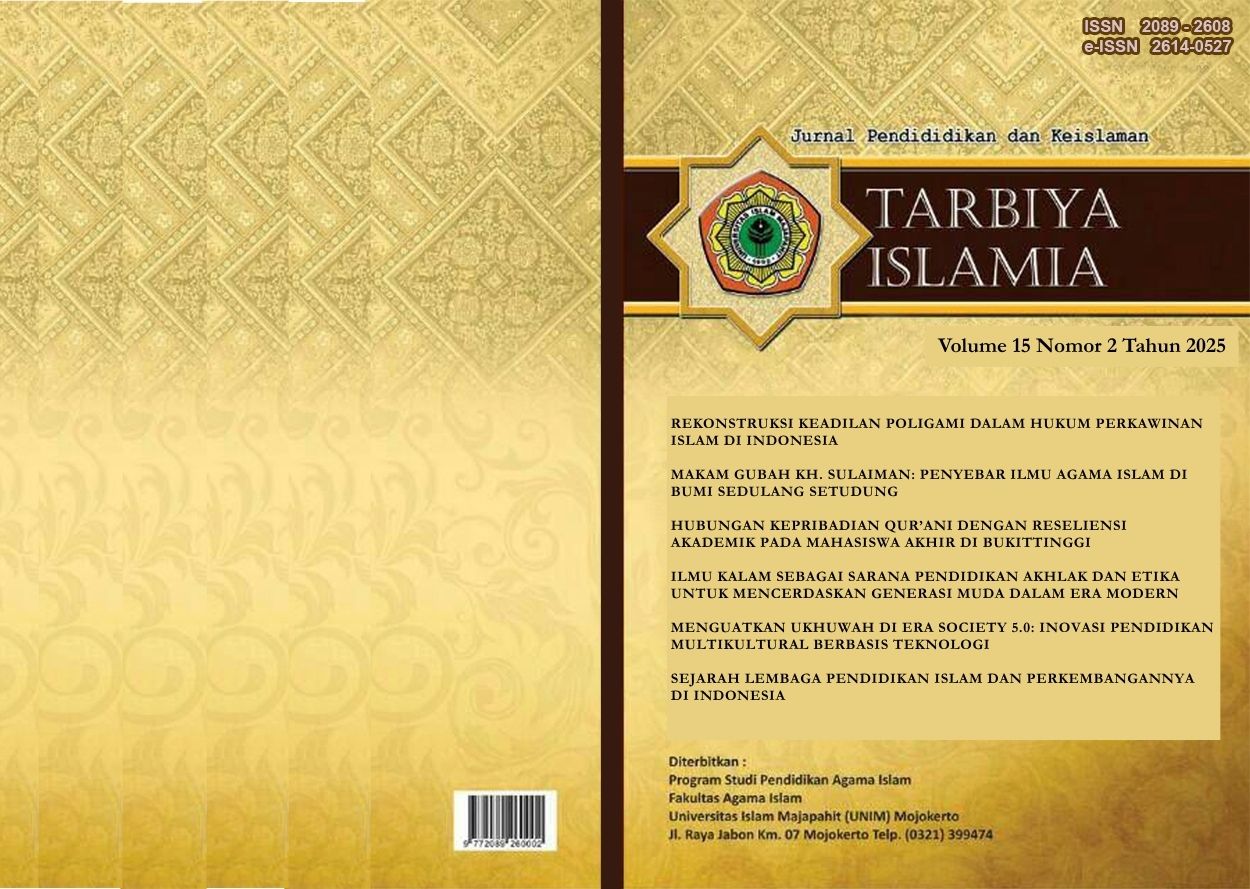
ILMU KALAM SEBAGAI SARANA PENDIDIKAN AKHLAK DAN ETIKA UNTUK MENCERDASKAN GENERASI MUDA DALAM ERA MODERN
DOI:
https://doi.org/10.36815/tarbiya.v15i2.3744Keywords:
Ilmu Kalam, Moral Education, Ethics, Youth , CurriculumAbstract
The focus of this research is on the significance of Ilmu Kalam as a tool for moral and ethical education in guiding youth in the modern era. Facing increasing moral challenges, today's younger generation requires an educational approach to instill strong moral values. This study aims to examine the role of Ilmu Kalam in moral and ethical education and its influence on character development among youth. Using a qualitative approach, this research employs library research to gather and analyze relevant literature. The findings reveal that integrating Ilmu Kalam into the formal education curriculum can boost students' moral and ethical awareness, motivating them to actively engage in social activities. The study concludes that applying Ilmu Kalam in education significantly contributes to shaping ethical and responsible individuals. This research recommends educational institutions integrate Ilmu Kalam into their curriculum as a strategic measure to guide and enlighten the younger generation.
References
Al-Attas, S. M. N. (1999). The Concept of Education in Islam: A Framework for an Islamic Philosophy of Education. International Institute of Islamic Thought and Civilization.
Astuti, M. (2016). The Effect of Problem-Based Learning and Level Intelligence of Students’ Critical Thinking on Kalamm Science. Ta’dib: Jurnal Pendidikan Islam, 21(2), 155–164. https://doi.org/10.19109/td.v21i2.951
Hairani, E., & Putri, E. M. (2024). Peran Ilmu Kalam dalam Memperkuat Spiritualitas Umat Islam. Al-Qalam: Jurnal Kajian Islam Dan Pendidikan, 16(1), 170–177. https://doi.org/10.47435/al-qalam.v16i1.2975
Hanafi, A. (1974). Theologi Islam (Ilmu Kalam). Bulan Bintang.
Jaoua, M. (2014). Science is a Gateway for Democracy. Science and Engineering Ethics, 20(2), 313–316. https://doi.org/10.1007/s11948-013-9455-2
Khasanah. (2024). Islamic Education as a Foundation of Character: a Case Study of the Formation of Noble Morals in Students. JIE (Journal of Islamic Education), 8(2), 294–309. https://doi.org/10.52615/jie.v8i2.541
Lickona, T. (1991). Educating for Character: How Our Schools Can Teach Respect and Responsibility. Bantam Books.
Mohapatra, S., Ganesh, K., Punniyamoorthy, M., & Susmitha, R. (2018). Research Gap, Objectives and Scope (pp. 21–24). https://doi.org/10.1007/978-3-319-67888-7_3
Mulyono, M. (2018). Kajian Pengembangan Ilmu Tauhid/ Kalam.Ulul Albab: Jurnal Studi Islam, 10(2), 143–154. https://doi.org/10.18860/ua.v10i2.6056
Misra, M. K. B. A. M., Senin, N. B., & Mutalib, M. F. M. B. A. (2023). Teaching The Science Of Kalam In Selected Higher Education Institutions In Malaysia. Intiqad: Jurnal Agama dan Pendidikan Islam, 15(1), 212-221. Muthahhari, M. (2002). Mengenal Ilmu Kalam. Pustaka Zahra.
Nurdiani, N. (2022). Pendidikan Ilmu Kalam dalam Pandangan Ismail Alfaruqi dan Hasan Hanafi. Journal Analytica Islamica, 11(2), 381. https://doi.org/10.30829/jai.v11i2.14056
Zuliani, S., & Munawaroh, S. (2024). Penerapan Manajemen Pendidikan dalam Memperkuat Karakter Siswa di Sekolah. At Tadbir: Islamic Education Management Journal, 2(2). https://doi.org/10.54437/attadbir.v2i2.1821
Downloads
Published
How to Cite
Issue
Section
License
Copyright (c) 2025 Nafiuddin, Khoirul Hidayat, Zuhro'ul Khoiriyah

This work is licensed under a Creative Commons Attribution-NonCommercial-ShareAlike 4.0 International License.
All rights reserved.
this publication may be reproduced, stored in a retrieval system, or transmitted in any form or by any means, electronic, mechanical, photocopying, recording. Consequently, form this copyright notice, the author(s) have copyright for this publication.